
2D robot vision
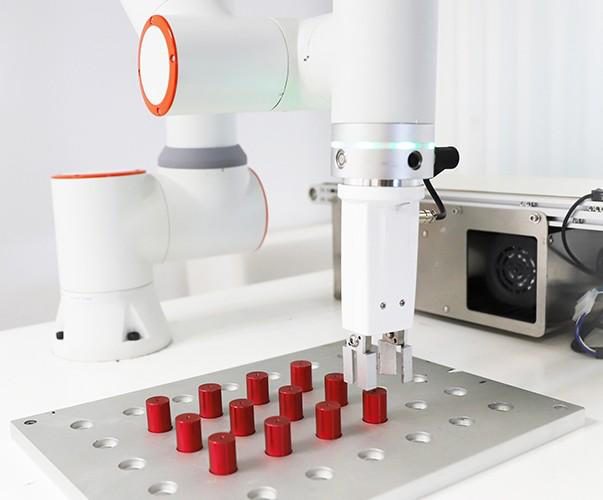
For conveyors, flat trays and fixtures with a known height. The camera determines horizontal position and rotation.
Knowledge · Robotics
Do not automatically choose the camera that produces the most data. Choose the simplest measurement approach that can guide the robot reliably under real production variation.
Start with the motion
When parts lie on a known plane, position and rotation within that plane are often sufficient. If height, tilt or free orientation also changes, depth information is required. Part presentation, gripper design and placement tolerance together determine whether 2D, limited depth measurement or full 3D is appropriate.
For conveyors, flat trays and fixtures with a known height. The camera determines horizontal position and rotation.
For visible parts whose height or orientation varies within a bounded working volume.
For randomly piled parts that partly hide one another and require new grasp and collision checks for every pick.
Decision matrix
| Question | 2D | 3D guidance | Bin picking |
|---|---|---|---|
| Presentation | Known plane | Variable height or pose | Random bulk |
| Required pose | Position and rotation in the image plane | Spatial position and orientation | Pose plus a reachable grasp |
| Calibration | Plane and camera-to-robot relation | Complete 3D coordinate chain | 3D chain plus bin and gripper |
| Main risk | Contrast and height variation | Surface response and pose confidence | Limited visibility, reach and collisions |
| Support burden | Usually the lowest | More calibration and computation | Most exceptions and recovery |
Four checks
If a fixed approach height and grasp position are no longer safe, 3D provides relevant information.
Free tilt requires spatial orientation and a repeatable transformation into robot coordinates.
A depth sensor does not automatically solve parts blocking one another from view. Bulk picking also needs grasp selection, reachability and recovery.
Measure capture, processing, robot motion, rejects and recovery together. More measurement data is useful only if the complete cell reaches the required capacity.
Cost and maintainability
Include camera, lighting, computing platform, calibration, software, engineering, validation, training and maintenance. Compare these costs with demonstrated value: fewer manual hours, lower ergonomic load, steadier output and fewer interventions. Use measurements from representative trials; a more complex 3D solution will not pay back when robust 2D covers the same process.
Representative trial
Share parts, presentation, gripper, tolerance and required cycle time. This allows a focused assessment of the variation covered by 2D and where depth is genuinely required.