
Industrial LED lighting
Machine vision lighting for reliable contrast
Lighting determines which contours, surface details, print and codes are visible to the camera. Hikrobot offers several lighting geometries for backlighting, direct illumination, low-angle illumination and controlled reflections. The best fit depends on the part surface and the feature you need to inspect.
View the lighting range
Hikrobot LED lighting
How the available lighting types differ
Backlights produce a silhouette, ring lights illuminate around the lens, line lights cover long or narrow areas, and coaxial lighting controls reflection from a flat surface. Each family is available in sizes and colours for different fields of view and materials.

MV-LBSS
Flat backlight · closed emitting surface
Uniform light behind the part creates a clear silhouette for dimensional inspection, edge detection and presence checks.
View MV-LBSS
MV-LBES
Flat backlight · central aperture
A uniform emitting surface with an opening for the optical path. This allows inspection close to the camera axis.
View MV-LBES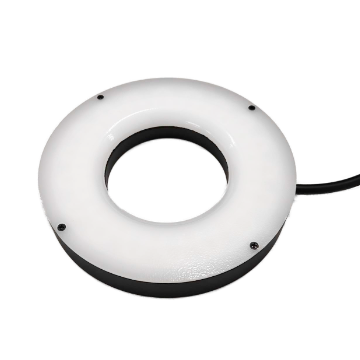
MV-LRDS
Ring light · adjustable geometry
Light from around the lens provides broad front illumination. Diameter, angle and colour can be matched to the field of view and the way the surface reflects.
View MV-LRDS
MV-LRSS
Shadowless ring light · diffused
A diffuser spreads white light over the part and softens shadows and local reflections. This is useful for print, characters and surfaces with small height differences.
View MV-LRSS
MV-LD
Spot light · compact field
Concentrated illumination for a small field close to the product. It can be combined with telecentric optics for marks and fine details.
View MV-LD
MV-LL
Line light · long narrow field
A narrow band of light for webs, line-scan systems and applications that require even illumination across a long width.
View MV-LL
MV-LC
Coaxial light · on-axis
On-axis illumination uses the reflection from a flat glossy surface. Flat areas appear bright while scratches, recesses and uneven features remain darker. It is less suitable for curved or matte parts.
View MV-LC
MV-LT
Tunnel light · cylindrical products
Light surrounds a cylindrical product so the sides of bottles, shafts and other round parts remain visible.
View MV-LTLighting selection
Geometry determines what becomes visible
The lighting geometry creates the contrast. Size and colour then determine coverage and surface response. A controller regulates intensity and continuous or strobed operation and synchronises the light with the camera trigger.

| Product | Suitable for | Available choices |
|---|---|---|
| MV-LB | Silhouettes, dimensions, edges and presence checks | LBES or LBSS; length, height, white or red |
| MV-LRDS | Codes and print where angle or colour affects contrast | Diameter 45 to 230 mm, 0 to 90°, blue, red or white |
| MV-LRSS | Even front illumination for print, contamination and characters | White, 80 to 300 mm |
| MV-LD | Small fields, marks and telecentric setups | Series, size, colour |
| MV-LL | Continuous material and line-scan systems | Length, height 30 or 40 mm, blue, red, white or IR |
| MV-LC | Flat glossy surfaces | Square 30 to 70 mm, blue, red, white or IR850 |
| MV-LT | Cylindrical products requiring illumination around the sides | Length 100 to 1500 mm, white |
Related components
Lighting as part of the imaging setup
Lenses
The lens determines field of view and working distance. Its view must remain within the evenly illuminated area.
View lensesLight controllers
MV-LE controllers regulate intensity, continuous or strobed operation and triggering for one to four lighting channels.
View MV-LEIndustrial cameras
Area scan, line scan and smart cameras for use with controlled machine vision lighting.
View cameras
Discuss the part and inspection with a specialist
Surface, working distance, field of view and cycle time determine which lighting geometries are worth comparing. We can help select the light, colour, controller and camera settings for your application.